Showing posts with label Comprehension. Show all posts

Thursday, December 3, 2020

Teacher Center: Tier I Comprehension Lesson using the Strategies Summarize and Connect

Welcome to another video of our Series: Teacher Center!
In these videos we use metacognition at its best! 

In today's "Teacher Center" video, we will be watching Whitney teach a TIER I comprehension lesson using the strategies Summarize and Connect. Enjoy!


We provide 5 things for you in our new Teacher Center videos:
1) Watch good teaching
2) Discuss what is being done/seen
3) Hear about the choices made when the lesson was planned
4) Hear about the choices made during the teaching
5) Discuss what ideas could be improved upon in the future or in different circumstances.

What a great way to learn from each other!  We hope you will share in our learning and be metacognitive with us about teaching!

Thank you Whitney for letting us into your classroom.
We are blessed to see you teach!


Tuesday, March 17, 2020

How to Plan a Comprehension Lesson

Need help planning Comprehension Strategy Instruction Lessons?  We have taken the time to walk through the thinking of how to plan a lesson in this video.  We want to help make strategy instruction easier and hope this does the trick!


Tuesday, December 10, 2019

Comprehension Instruction: What is it and why do we teach it?

Let us help you understand what to do DURING reading to help you and your students make deep meaning from text!  Reading comprehension instruction is important to understand in order to help make your reading and teaching meaningful!  We include information about discussion, strategy instruction, metacognition, Jottings, and skills versus strategies.

Enjoy the video!


(Strategy Posters, Graphic Organizers, Trackers, and more!)

Thursday, July 11, 2019

5 Lesson Tips and Reminders for Teaching Comprehension Strategies

Today's video is all about 5 simple tips to remember while teaching reading comprehension strategies!


These five things are not a complete list of all that you need to have a flawless lesson, but they are a great start when planning for success!  Angie calls them non-negotiables!

These tips can apply to other teaching too!  Not just comprehension instruction!  So pay close attention and maybe they can help you in other areas of instruction also.

Comprehension Resources Handout

Tuesday, July 9, 2019

How to Choose Comprehension Strategies Using our Flow Chart

Today is all about CHOOSING COMPREHENSION STRATEGIES made simple!  We have done the hard thinking for you and made a simple flow chart for your use for free.  Watch our video and use these easy steps in the flowchart to determine your reading strategies. Then, follow the tips and reminders for lesson plans that will help your students deeply comprehend their text. We even give you explicit language for each strategy!


Here is our “Choosing Comprehension Strategies” flow chart to use as a way to quickly choose your strategy(ies) for instruction.  This is something we both use as we plan our own comprehension strategy instruction.  I, Angie, use it to plan lessons for my pre-service students when I model comprehension lessons and Whitney uses it for her daily comprehension instruction as a classroom teacher.  We have found it to be a valuable tool for our planning. 

We have also provided some teacher language for the strategies.  The teacher language will help you introduce the strategies and give you a starting point for your modeling.  Don’t forget that you have to include a think-aloud of how you used the strategy! The teacher language will guide you but is not a think-aloud during your modeling of strategy use. If you still need more help on what to do next, see one of our comprehension lessons with the teacher talk already filled in. We also have posters of the strategies and graphic organizers ready for your use in your classroom.  These can help keep you on track with your strategy instruction and use.

Most importantly, don’t give up!  Keep trying to use comprehension strategies in your instruction.  Students need these strategies so when they read on their own they have the thinking to be able to comprehend difficult and complex text without the support of a teacher to guide them. 
Good luck in your future comprehension planning!

FREE Comprehension Resources Handout (Flow Chart, Teacher Language, and More!)
Comprehension Graphic Organizers and Posters
Comprehension Lessons


Saturday, July 6, 2019

NEW Graphic Organizers for Comprehension Strategy Lessons!

Download the preview today HERE to see what is all inside this 150+ page download! 


Stay tuned for videos that we will reference to these graphic organizers
Make sure you subscribe to our YouTube channel today to not miss out! 

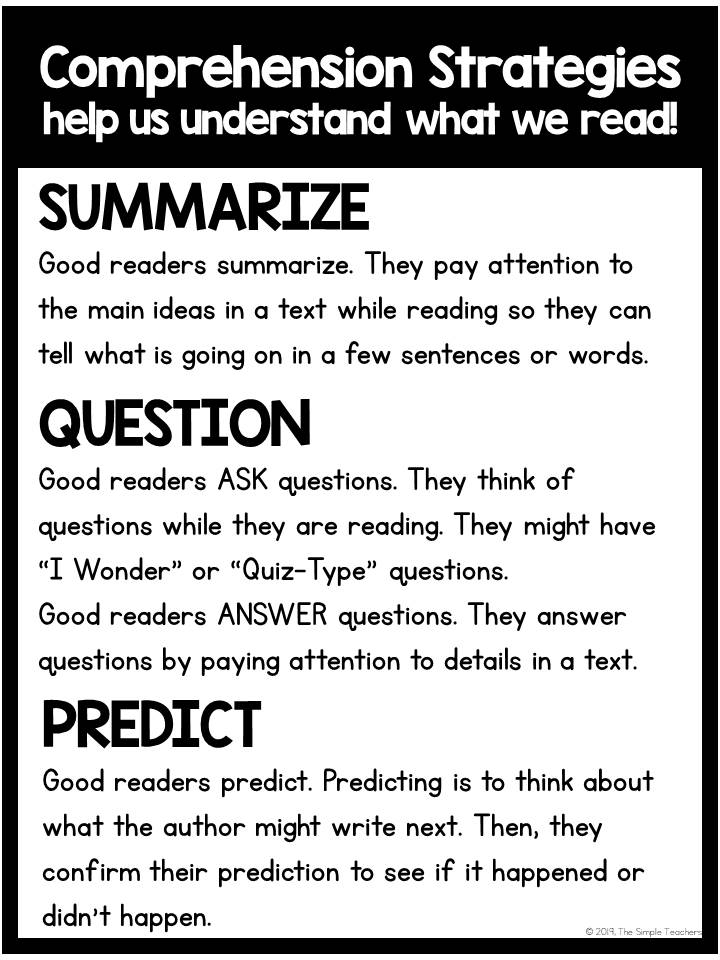
Comprehension Strategies

Strategies that we use to understand text are done primarily during reading. They occur in our heads as we read. Good readers are able to use strategies. Novice readers, on the other hand, often need to be taught how, when, and why we use strategies. 
The best way to ensure that a reader learns to use a strategy is first, one at a time and then, combining strategies into multiple strategy lessons.  
All of these variations of strategy lessons need to follow the Gradual Release model; I do with teacher modeling and think-aloud (page 4-5), We do, You do together, and You do alone. Click here for comprehension strategy posters!

Graphic Organizers

Graphic organizers are exactly what they say, they are graphic representation that organize our thinking and keep track of information found within the text. Use these graphic organizers with the comprehension strategies you choose for the texts you are teaching.  Use our flow chart (page 3) to help choose your strategy(ies)! 

When planning a comprehension strategy lesson, it is important that you completely read, select stopping points, and fill in a graphic organizer during your lesson creation so when you turn the kids out for the You do together and You do alone portion of the lesson you already have your thinking down on your own graphic organizer.  

Being prepared allows you to engage in conversation, discussion, and generate elaborative responses from your students as another means of assessing their comprehension of the text. After all, discussion is still one of the very best assessments of comprehension we can use. A graphic organizer can assist in that assessment. The graphic organizer is not the focus of the comprehension strategy lesson, but is the keeper of our thoughts until we can get to the time for discussion.


Tuesday, July 2, 2019

What and Why of Comprehension Strategies

In this video we teach you what the comprehension strategies are and why we teach them. Comprehending what we read is the GOAL of reading instruction.  It is why we do everything else!  Comprehension strategy instruction is one way to aide comprehension.


Strategies are "ways of thinking" made clear through modeling and thinking aloud.  These strategies happen in our heads mostly during reading so we have to stop during our lessons and talk about our thinking as we go or we have missed the opportunities to teach about the thinking that is occurring.

There are many strategies,but we have chosen to narrow our list down to a few that are most common.
Visualize
Question
Connection
Evaluate & Comment
Monitor & Clarify
Summarize
Predict
Infer 

As you pay attention to your own strategy use as a reader, you will find it easier to teach these strategies to your students.  We give many tips and helps for you to rely on our thinking until you are able to pay attention to your own thinking. It is our goal for you to be deep thinkers and to then get your students to be deep thinkers, using strategies when they are appropriate and helpful to understand the text they are reading!

FREE Comprehension Resources Handout
Comprehension Posters 


Thursday, June 27, 2019

How to Use the Reading Components in Your Classroom

Watch our YouTube video as we explain how to use the reading components in your classroom (k-6)! Our video and informational FREEBIE gives you an overview of: 
What each reading component is
How we can assess each component, and 
What effective instruction should include.


The reading components include oral language, print awareness, letter knowledge, phonological awareness, phonics, fluency, vocabulary, and comprehension. We hope this video and download will help clarify these very important aspects of literacy and will help you include each of them in your daily teaching.

Reading Components Handout
Fluency Resources 
Comprehension Resources
Phonics Resources 


Monday, June 24, 2019

New Reading Comprehension Strategies Posters

We created NEW Comprehension Strategy Posters!


We made them black and white with clean and simple graphics that all grades can use!
Included are full page and half page versions of the posters. Download the posters HERE!

Don't forget to download our FREE Comprehension Resources Handout for the flowchart, lesson tips and reminders, and explicit teacher language.

Make sure you go follow us at YouTube, we will be posting two videos a week starting tomorrow! Soon, we will be posting a video that will give you more information on Comprehension Strategies.


Friday, May 17, 2019

Freebie! Weekly Planning Template

Have you ever struggled with your weekly reading/writing planning? Is it taking you way too long? Would you like a trick that may save you time and help keep your planning organized? We have just the tool for you!

Check out this great Weekly Planning Template FREEBIE for reading and writing. The planning template will help you with your weekly mapping and planning for all of the reading components and writing. Using this planning template will help you align your instruction across the week.

This lazer focus will make you more aware of how you provide gradual release and practice of the most important skills and strategies within each of the reading components EVERYDAY!

Click here for the free download.


Sneak peek of a Kindergarten option...


Sneak peek of a 3rd Grade option...


Monday, February 11, 2019

The Stories Julian Tells Comprehension Guide


The Stories Julian Tells is a great chapter book for 2-3 graders. We have written a comprehension guide to help students learn and practice how to apply metacognative thinking strategies while they read. The comprehension strategies chosen in this guide are: summarize, question, and predict. Use this resource for TIER I guided release instruction, TIER I independent practice, or TIER II intervention with a comprehension focus. In Whitney's 2nd grade class, her high reading groups used this text and lesson as an independent practice which then facilitated discussion in a small reading group. This can be adapted to a variety of comprehension needs.
(Do you use Reach for Reading? This text is included in the 2nd grade Unit 6 small group independent books.)
Download includes (Written for The Stories Julian Tells):
-Reading strategy poster for summarize, question, and predict
-Bookmarks with strategy language for student reference
-Filled in Graphic Organizer for teachers
-Blank Graphic Organizer for students
-Vocabulary for some of the chapters
-After reading discussion questions
-FTAAP Task Analysis graphic organizer (teacher and student copies)

Enjoy a sneak peek...


Click HERE to download product!

Thursday, December 13, 2018

January 2019 Teacher Support Group


Tools for the Discussion...

1. Read this article prior to the discussion
2. Note taking page (We will have copies for you at Angie's house.)
3. To be given our "Do" teaching resource, you'll need to either attend the meeting at Angie's house or watch our Facebook live video! If watching the video, please like our Facebook page and share the video.

Monday, November 19, 2018

November Teacher Support Group


November 2018 Topic: Reading Comprehension - What Every Teacher Needs to Know


Tools for the Discussion...

1. Read this article prior to the discussion
2. Note taking page (We will have copies for you at Angie's house.)
3. This month, to be given our FREE "Do" teaching resource, you'll need to either attend the meeting at Angie's house or watch our Facebook live video! If watching the video, please like our Facebook page and share the video. We will send you a link to our free "Do" resource.

Thursday, February 15, 2018

February Teacher Support Group

If you missed our January discussion (click here to watch the video), catch up with us this month! Angie's husband, who is a LCSW licensed clinical social worker, will start our meetings with a "be well" message. Angie will help you learn and Whitney will provide you with some tools to help you do what you learn.

BE WELL FEBRUARY!


FEBRUARY LEARN AND DO!

February Topic: COMPREHENSIVE READING MODEL

Tools for the Discussion...
Read prior to the discussion: Teaching Reading Sourcebook - Comprehensive Reading Model Chapter
Note taking page (Click here)
Literacy Grouping Quick Steps
Comprehension Strategy Trackers (Click here)
Reading Elements "Drill Down" for Assessments Guide (Click here)
RTI Phonics Intervention Grouping Spreadsheet (Click here) - You Can copy and save the document to your Google Drive. This format could be used for any reading element needed intervened.


Friday, February 24, 2017

Spring ComprehensionLessons

Enjoy our Spring Comprehension Lessons!


The Ugly Vegetables
Lesson: TPT Link
Book: Amazon.com

The Tiny Seed
Lesson: TPT Link
Book: Amazon.com

Library Lion
Lesson: TPT Link
Book: Amazon.com

Monday, January 30, 2017

January and February Comprehension Lesson Plans

Enjoy our January and February Comprehension Lessons!


January:

Akiak
Lesson: TPT Link
Book: Amazon.com

Happy Birthday, Martin Luther King!
Lesson: TPT Link
Book: Amazon.com

February:


Each Kindness
Lesson: TPT Link
Book: Amazon.com

Henry's Freedom Box
Lesson: TPT Link
Book: Amazon.com

Looking at Lincoln
Lesson: TPT Link
Book: Amazon.com

Somebody Love's You, Mr. Hatch
Lesson: TPT Link
Book: Amazon.com


Tuesday, January 3, 2017

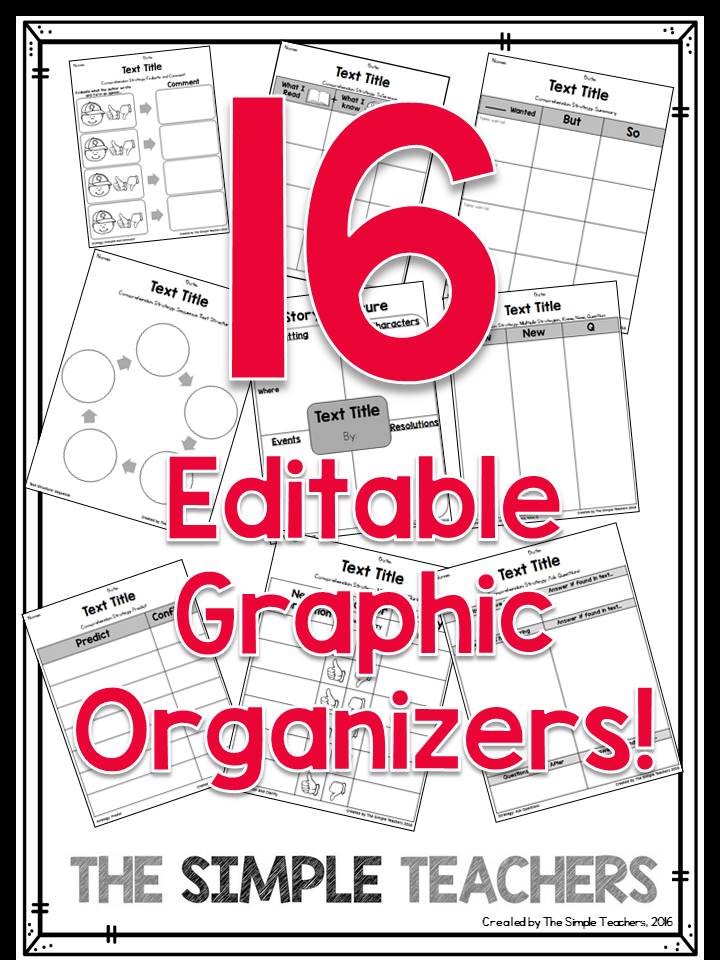
Comprehension Graphic Organizers

16 Editable Graphic Organizers

Strategies:
Predict, Inference, Monitor/Clarify, Visualize, Question, Summarize, ConnectEvaluate/Comment, Story Structure, Knew, New, Q

Text Structure:
Cause/Effect, Problem/Solution, Question/Answer, Description, Sequence or Time Order, Compare/Contrast

 11 Editable Multistrategy Graphic Organizers

Multistrategy Graphic Organizers included:
·         Knew, New, Q, Monitor and Clarify,  Predict and Summarize with somebody, wanted, but, so, Reciprocal Teaching, Summarize and Comment, Summarize and Infer, Summarize and Predict, Summarize and Question, Summarize, Predict, and Question, Summarize, Comment, and Predict, Summarize, Comment, and Question


Comprehension Strategies
Strategies that we use to understand text are done primarily during reading. They occur in our heads as we read. Good readers are able to use strategies. Novice readers, on the other hand, often need to be taught how, when, and why we use strategies. The best way to ensure that a reader learns to use a strategy is first, one at a time and then, combining strategies into multiple strategy lessons. All of these variations of strategy lesson need to follow the Gradual Release model; I do with teacher modeling and think-aloud, We do, You do together, and You do alone.

Graphic Organizers
Graphic organizers are exactly what they say, they are graphic representations that organize our thinking and keep track of information found within the text. Graphic organizers are best when they match the text they are being used with. These editable graphic organizers are meant to be used with the comprehension strategies you choose for the texts you are teaching. The best way to determine what strategy to use in a text you are teaching is to read the text and think about what strategy you are using (be metacognitive, after all isn’t that what we want our students to be able to do?!). That is always a good place to start.

The benefits of using graphic organizers or concept mapping has been seen in a wide range of practices. The use of graphic organizers during comprehension instruction is first, a good way to teach students how to use strategies as they see you writing and talking about your own thinking, but they are also a good way to assess their strategy use. You can use what they have written on their own organizer as a part of assessing their strategy use.

Planning a Comprehension Lesson
When planning a comprehension strategy lesson, it is important that you completely read and fill in a graphic organizer during your lesson creation so when you turn the kids out for the You do together and You do alone portion of the lesson you already have your thinking down on your own graphic organizer. Having this done allows you to engage in conversation, discussion, and generate elaborative responses from your students as another means of assessing their comprehension of the text. After all, discussion is still one of the very best assessments of comprehension we can use. The graphic organizer is not the focus of the comprehension strategy lesson, but is the keeper of our thoughts until we can get to the time for discussion.


Reciprocal Teaching UPDATE!

Download our Reciprocal Teaching for Literacy Groups Mega Pack

WE HAVE UPDATED THIS PRODUCT!!

  • MANY MORE graphic organizers that include a place for you to write stopping stops for your students. There are also g.o.s with chapter headers for use during chapter books. 
  • Binder Labels
  • More strategy poster options
Student Example of a student's work Summarizing and Predicting 


Reciprocal Teaching (Palinscar & Brown, 1984) uses the strategies Summarize, Predict, Clarify, and Question together and the goal is for the students to be able to do the thinking and the discussing about a text on their own. I have found it important to teach each strategy separately before teaching them together. Then it is important to use reciprocal teaching in a gradual release model during whole group comprehension lessons before they are ready to do the thinking and especially the discussion on their own.

We have included a variety of items for you to use as you teach the strategies in isolation or in different combinations. You can use these in whole-group settings with a gradual release method, or in small-group lessons.

Click here to access the resource on TPT!